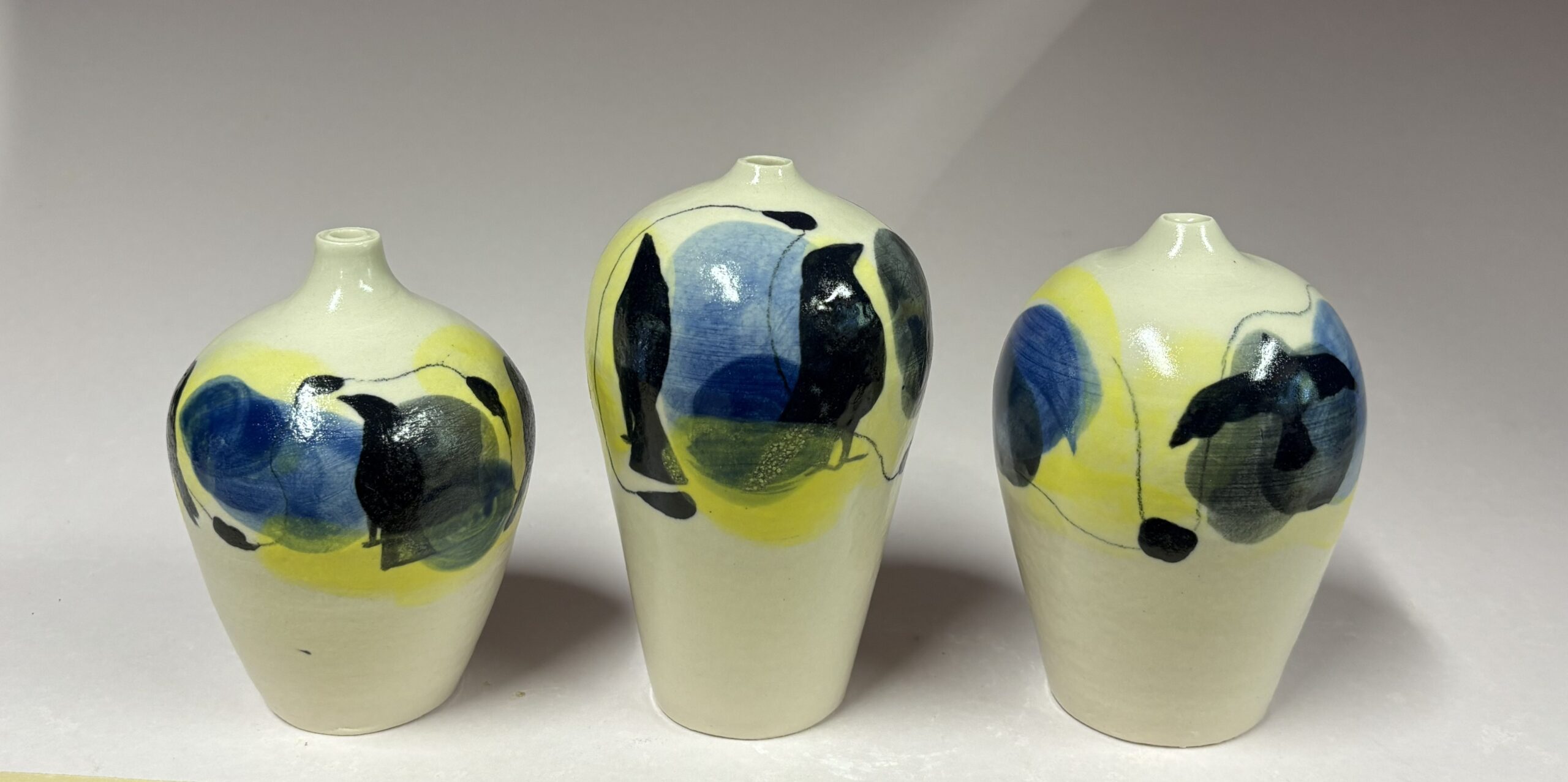
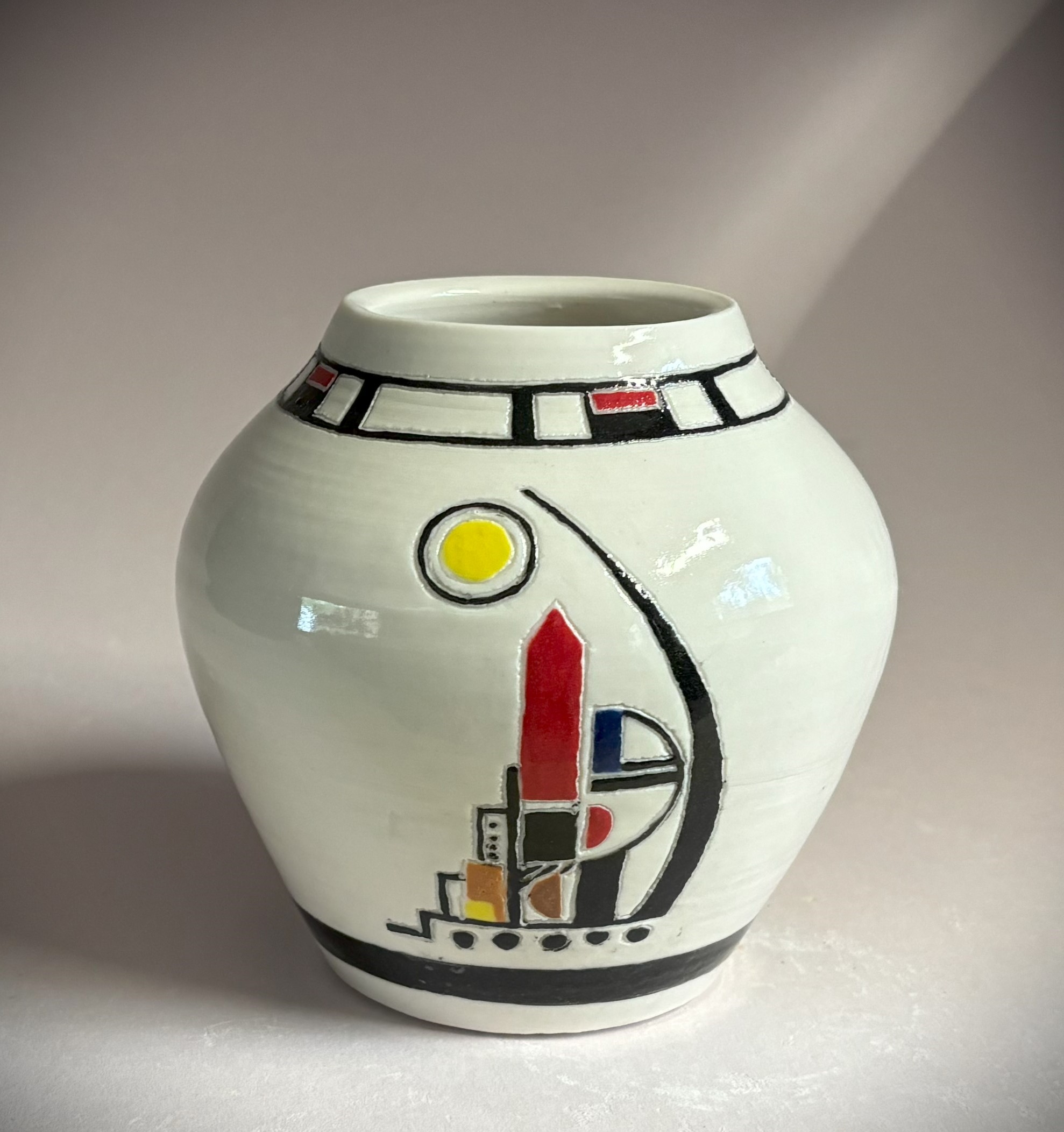
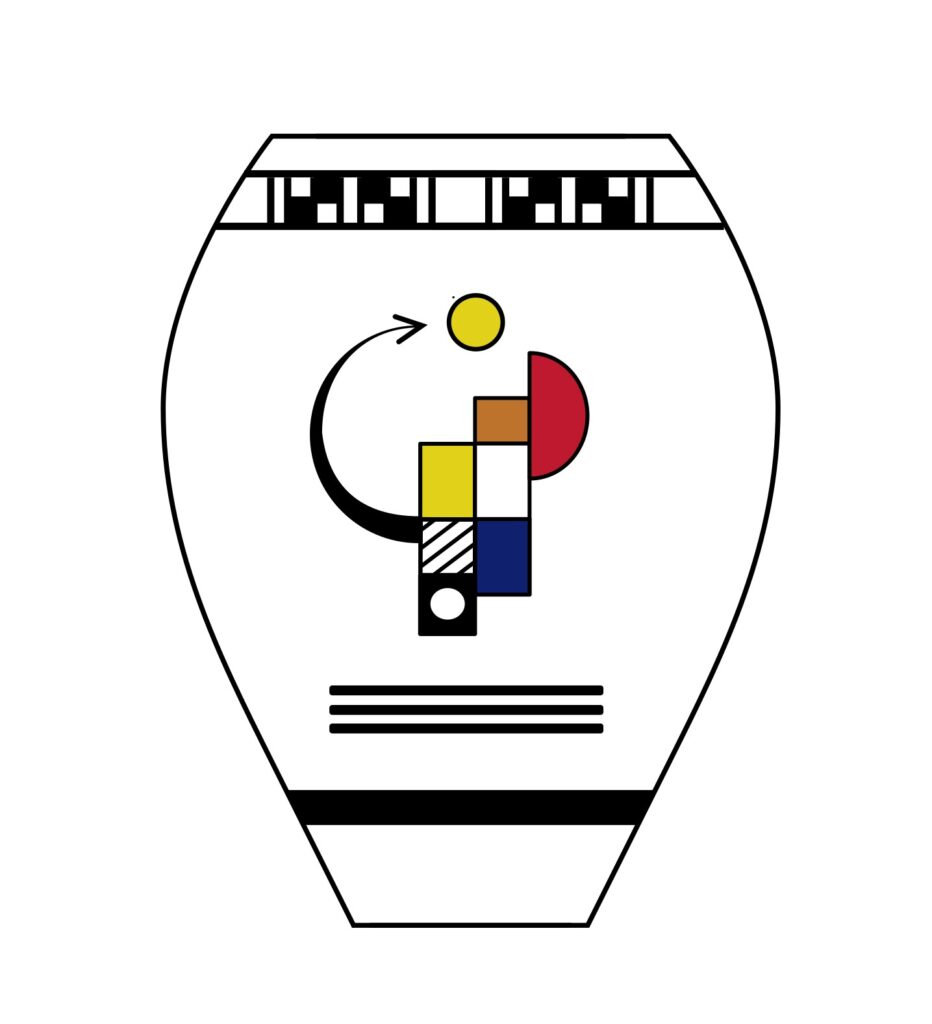
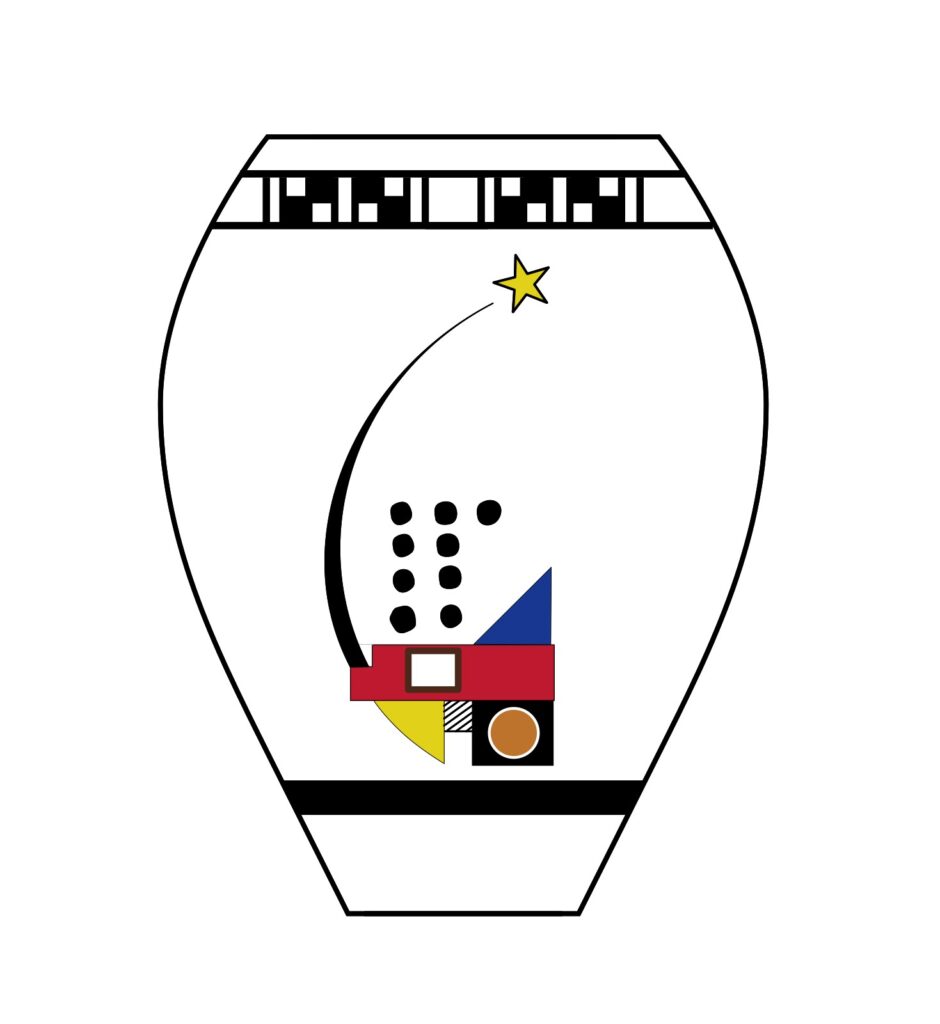
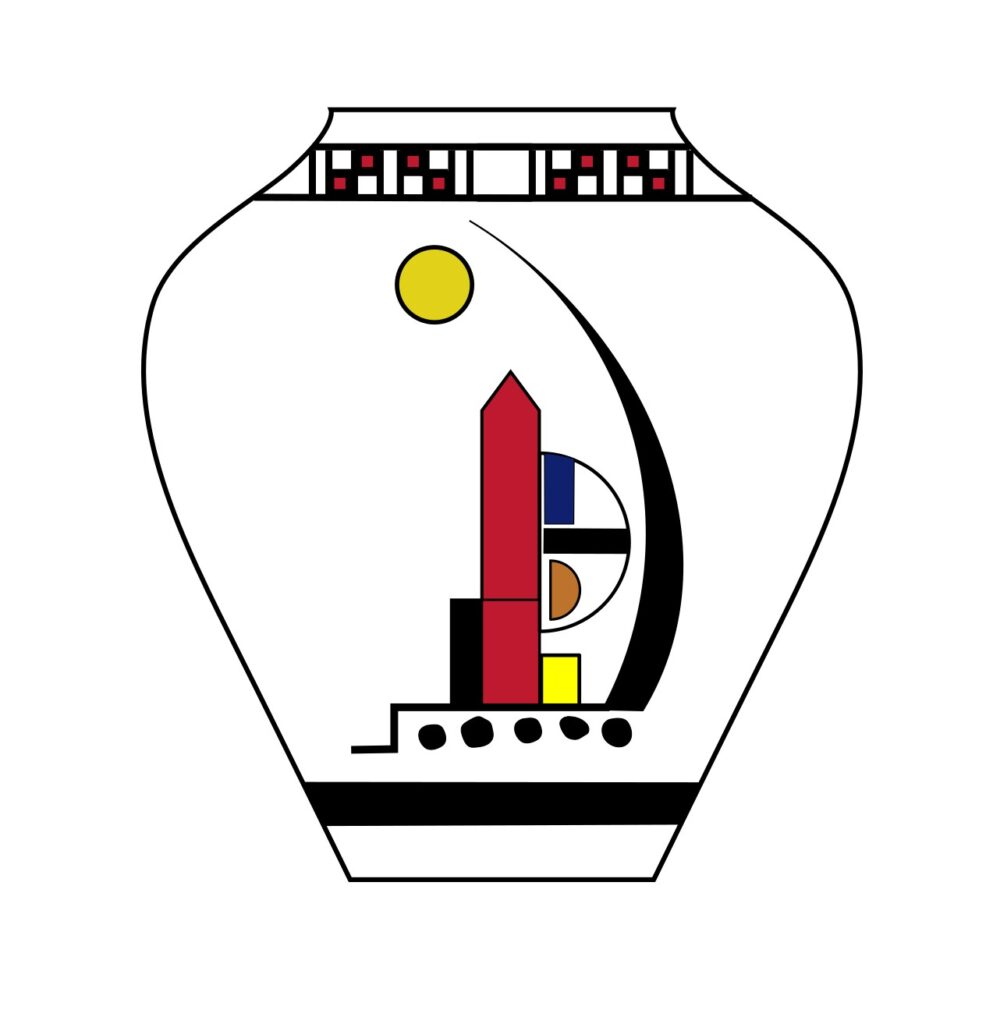
I am continuing to explore this color combination, now with added raven designs. The tallest one shown here is 8″. The yellow under glaze does not like to be painted over the black, as it crinkles the surface, but the reverse is not a problem. I am please with this progress and encouraging result.
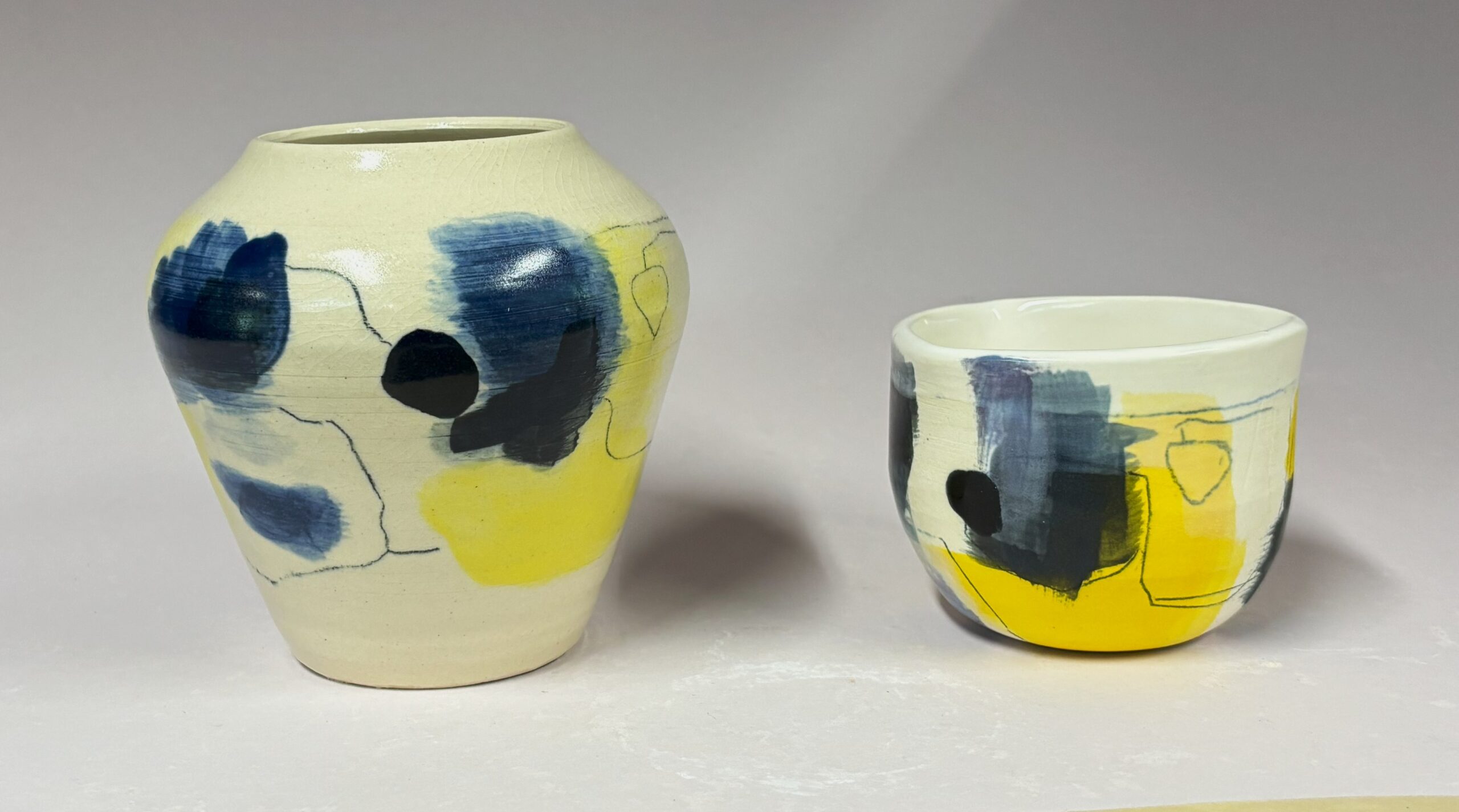
The porcelain cup on the right was made by Barbara Dibble, a member of the Clay Center in St. Petersburg, FL. I purchased it from the Florida CraftArt Center (St. Pete) last year and was intrigued with the loose brush work, color pallete and connecting pencil lines. I tried to copy it, hoping to learn something new in the process. My stoneware vase on the left has a sprayed, Polseno matt glaze, cone 5, and the underglazes are Mayco Fundamentals (Kings Blue, UG001; Jet Black, UG050 and Bright Yellow, UG046). After experimenting with several type of black lines, I settled on using an Amaco underglaze pencil, jet black, No. 11420F. My next step is to try to integrate this knowledge into an original piece.
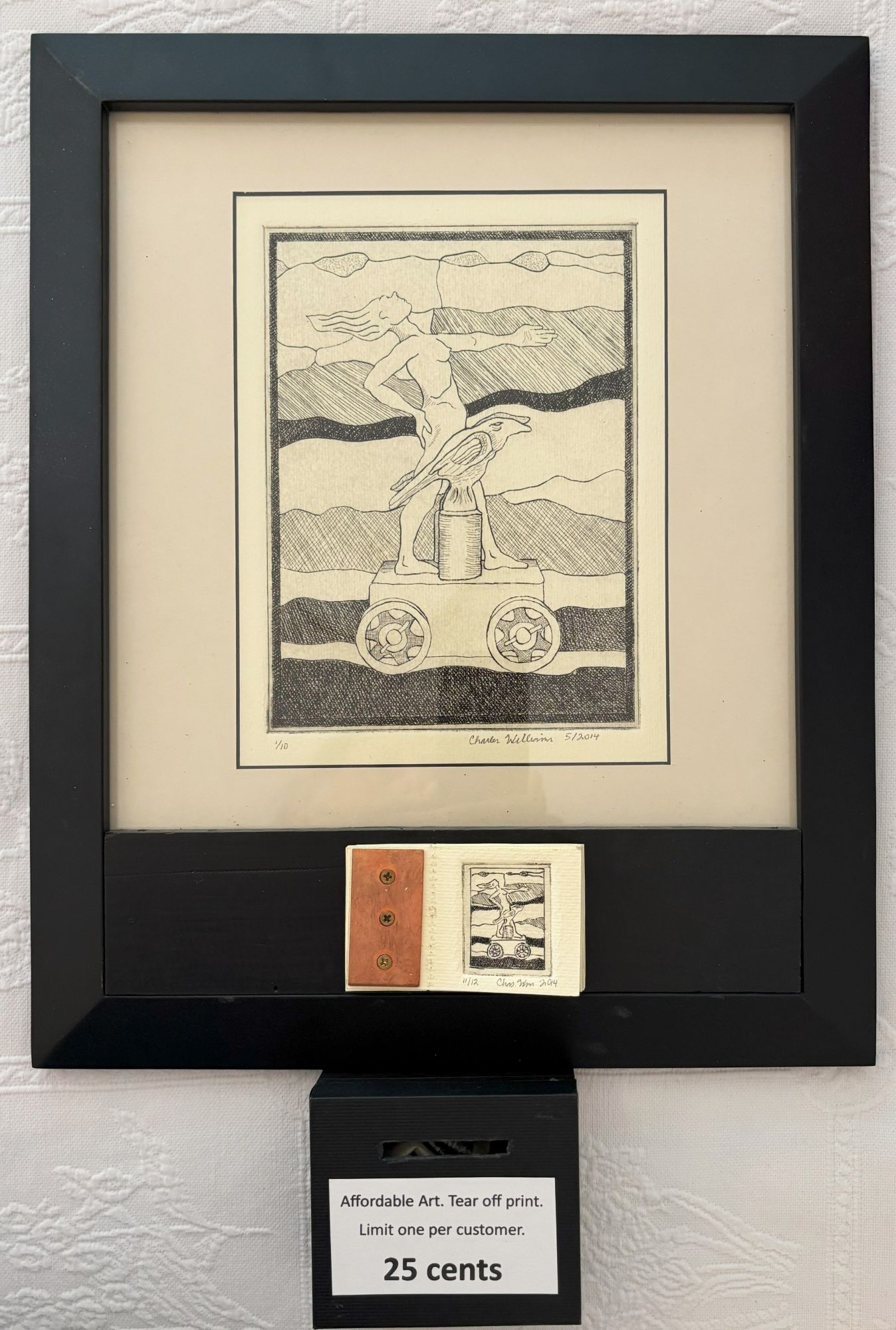
In 2014, I made this etching, and in the spirit of Marcel Duchamp, I allowed one to purchase, for 25 cents, one of 12 microprints of the original etching. A box is attached to the bottom of the frame for one to deposit the coin and tear off the print. I just exhibited this work at my church’s art galllery but the microprints sold out! I made 13 more and rehung the etching. There are two weeks left until the gallery show ends; I hope they last.
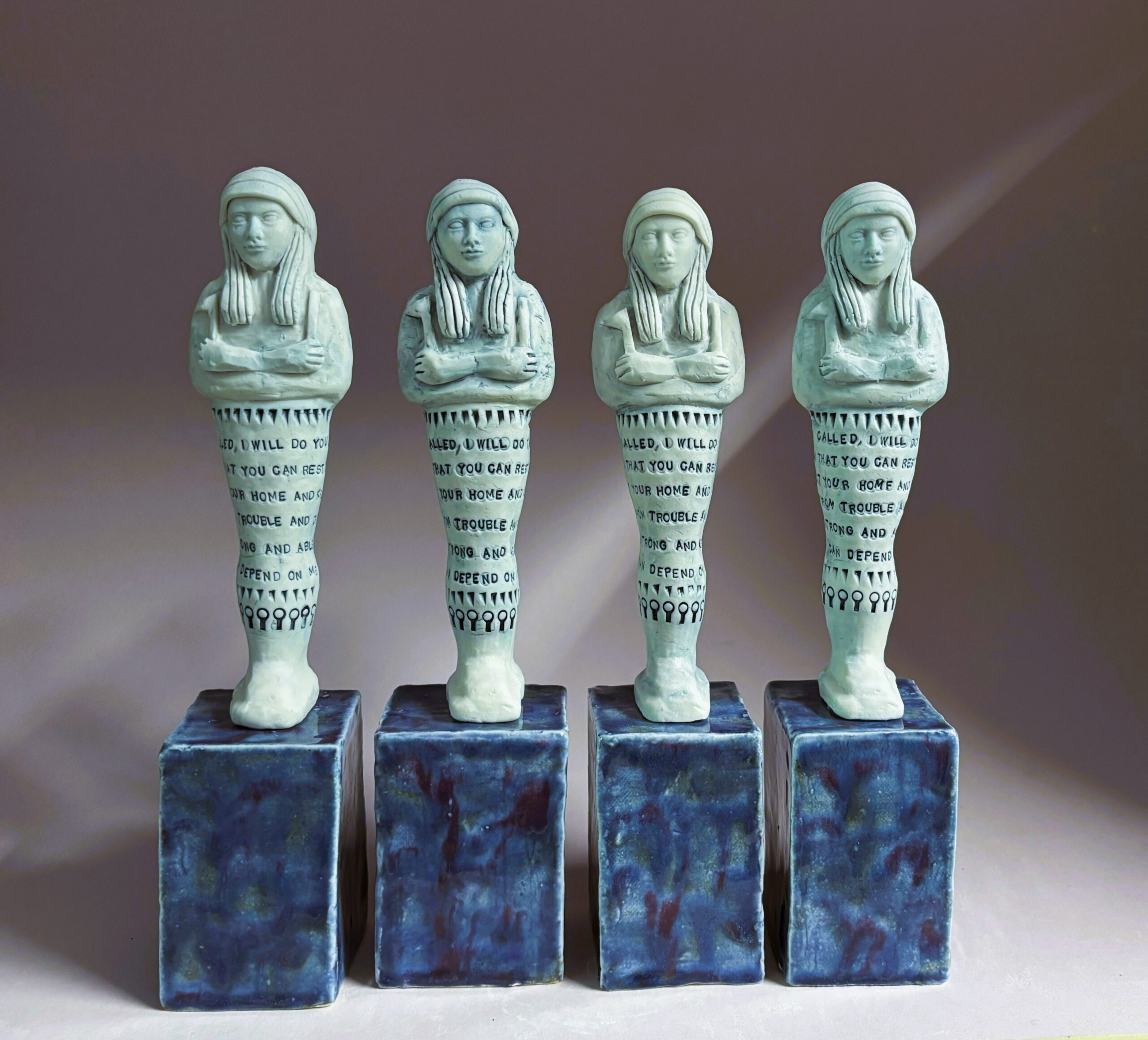
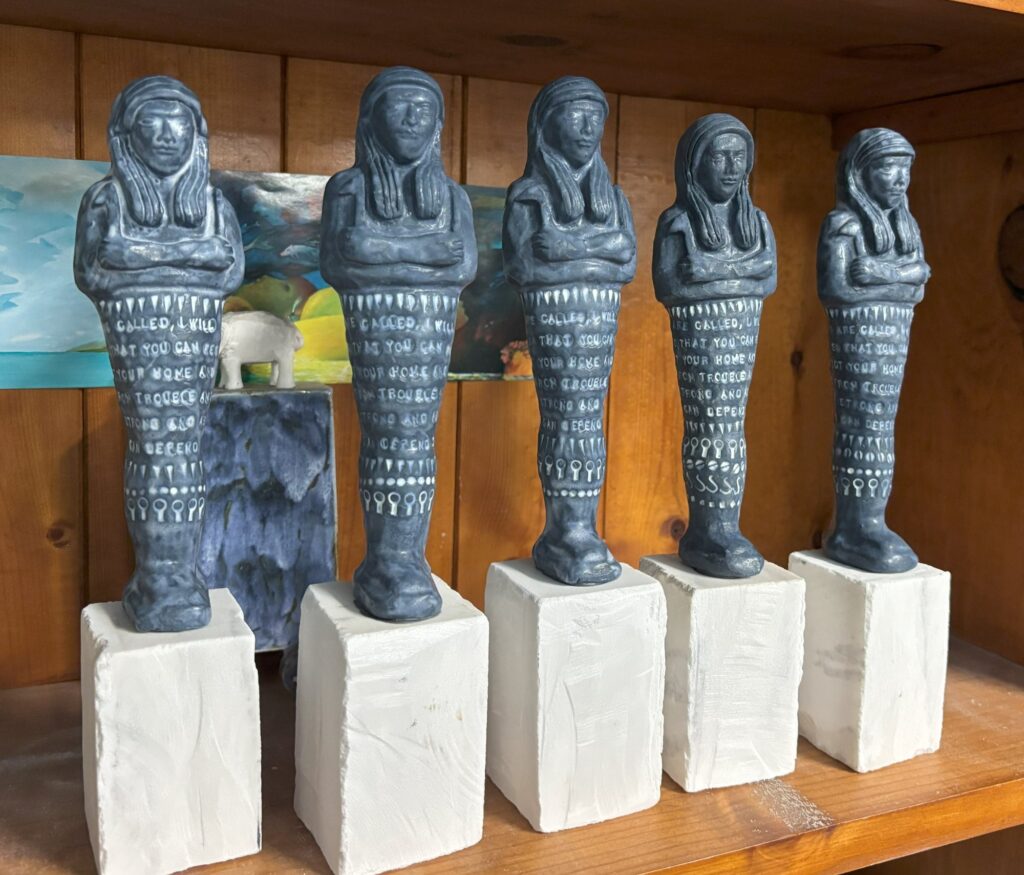
Illustrated are a group of my most recent “blue” Shawabtis which are the newest of an ongoing series made during the last 15 years. The series addresses my belief that people in the present world need help with their everyday troubles. This help might be solicited through use of ancient Egyptian style sculptures that beckon help from the afterworld. A request for protection and assistance is printed (in english text) around the body of each figure. Each Shawabti is made from porcelain, and the bases are either marble or clay; materials unchanged for millions of years until now transformed.
It has been some time since I last posted, as my art work has been rather sparse. I did make a few shawabtis however.
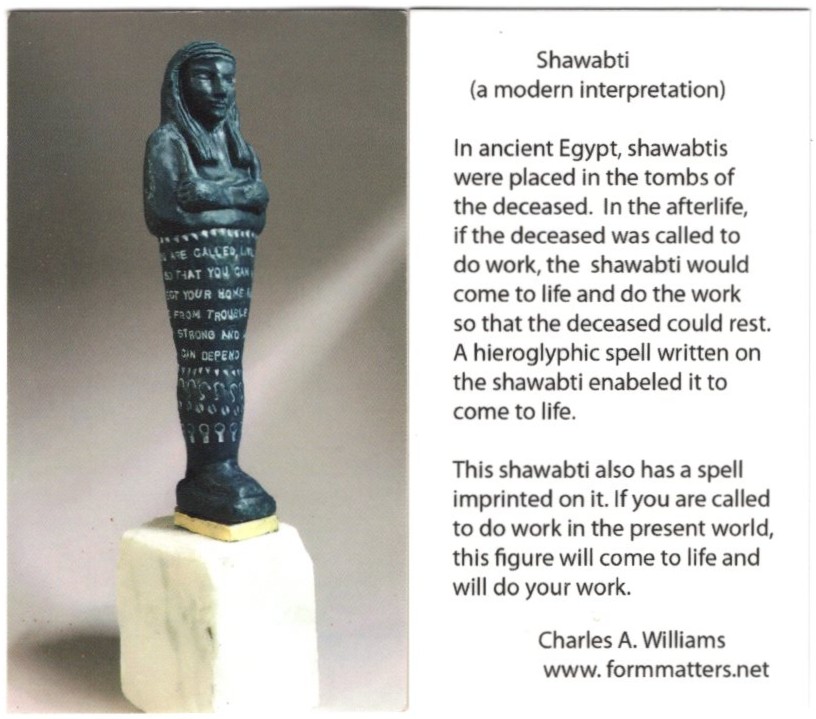
Some years ago I made a small “art signature” card about my shawabtis (below). I thought I would be making hundreds of these sculptures, but that did not turn out to be the case.
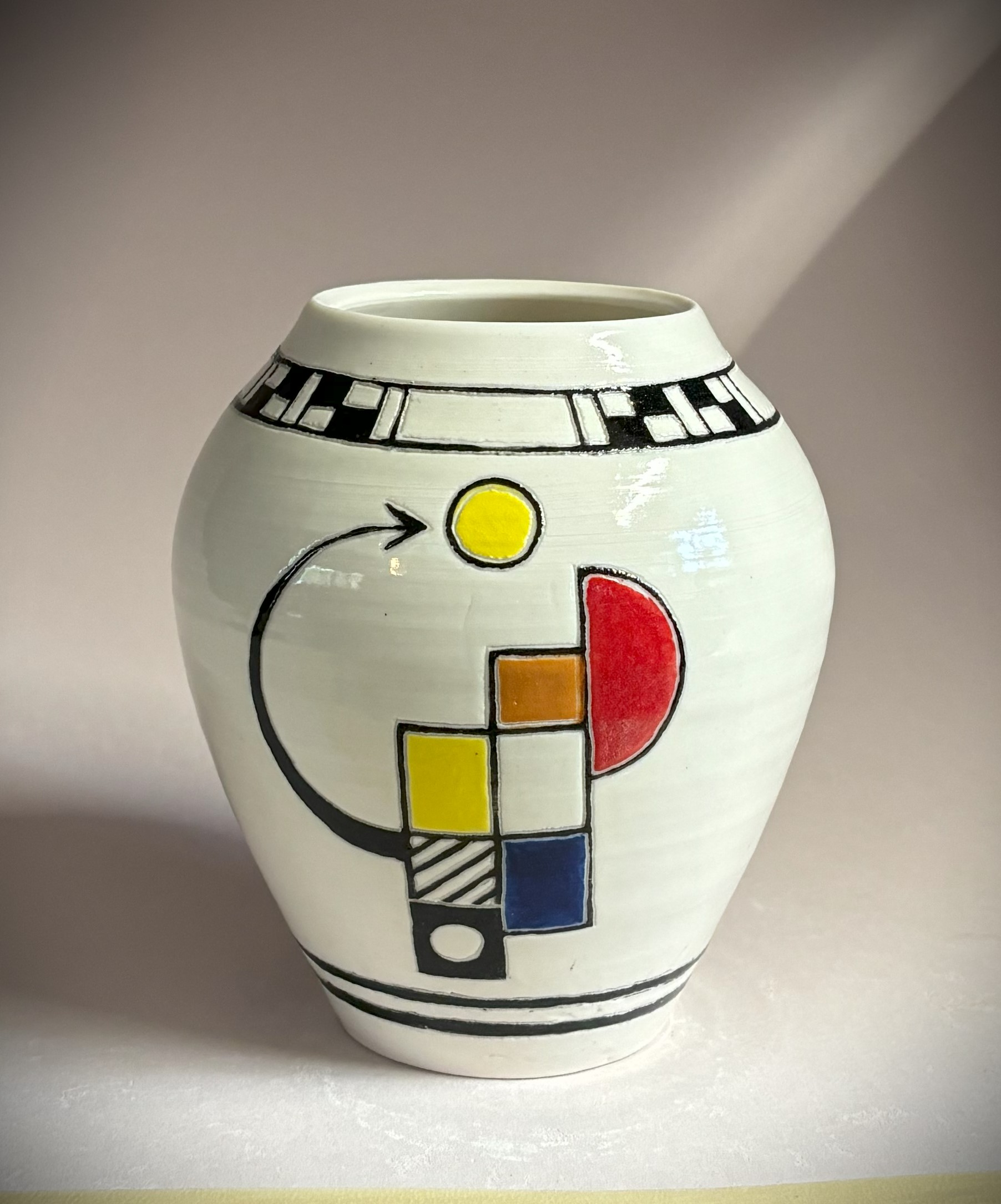
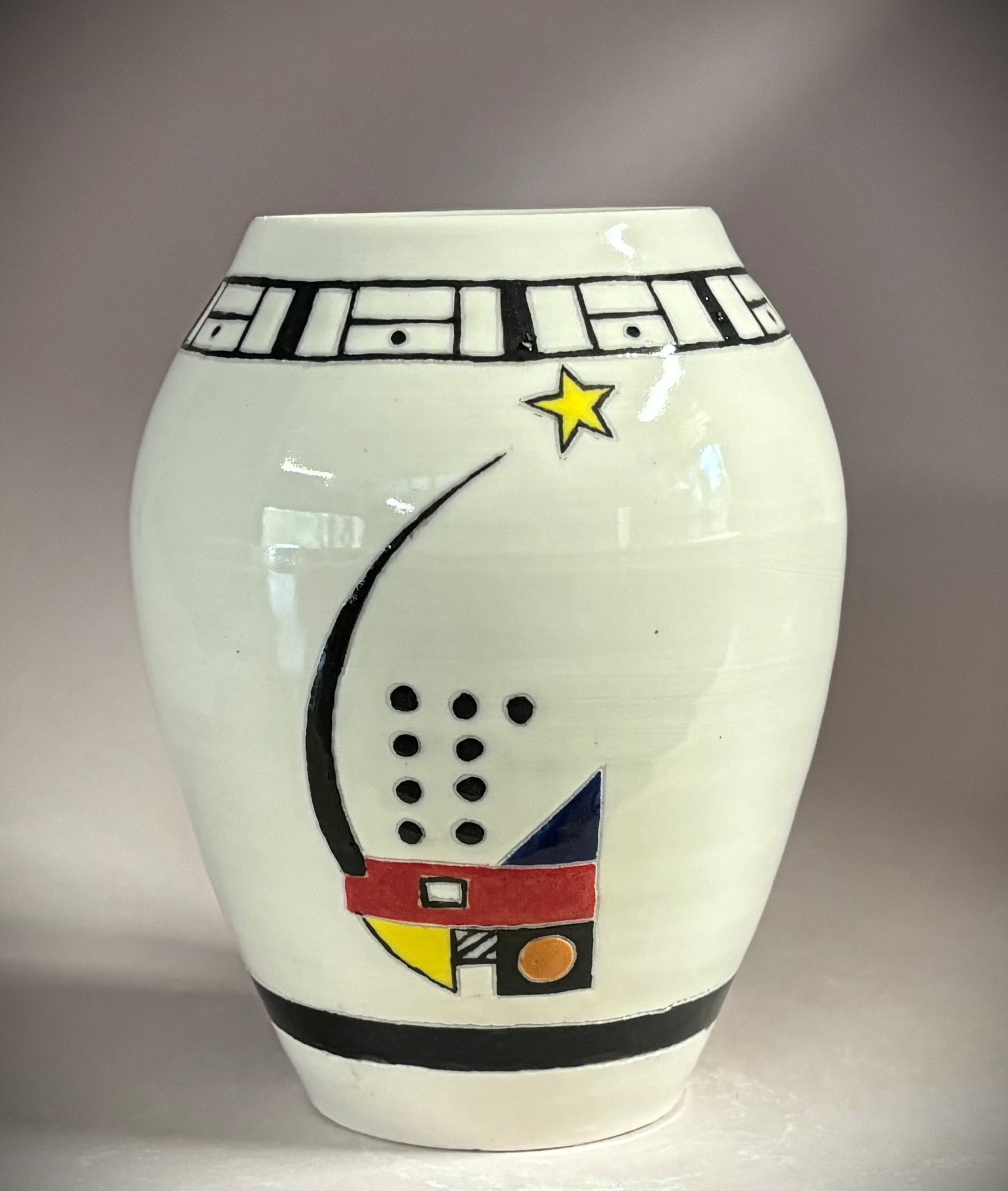
These are the new porcelain pots since last blog posting. The previously posted designs are shown again, below. The pots are about 7 inches tall, fired to cone 6 with underglazes and a clear overglaze all initially applied to the greenware.
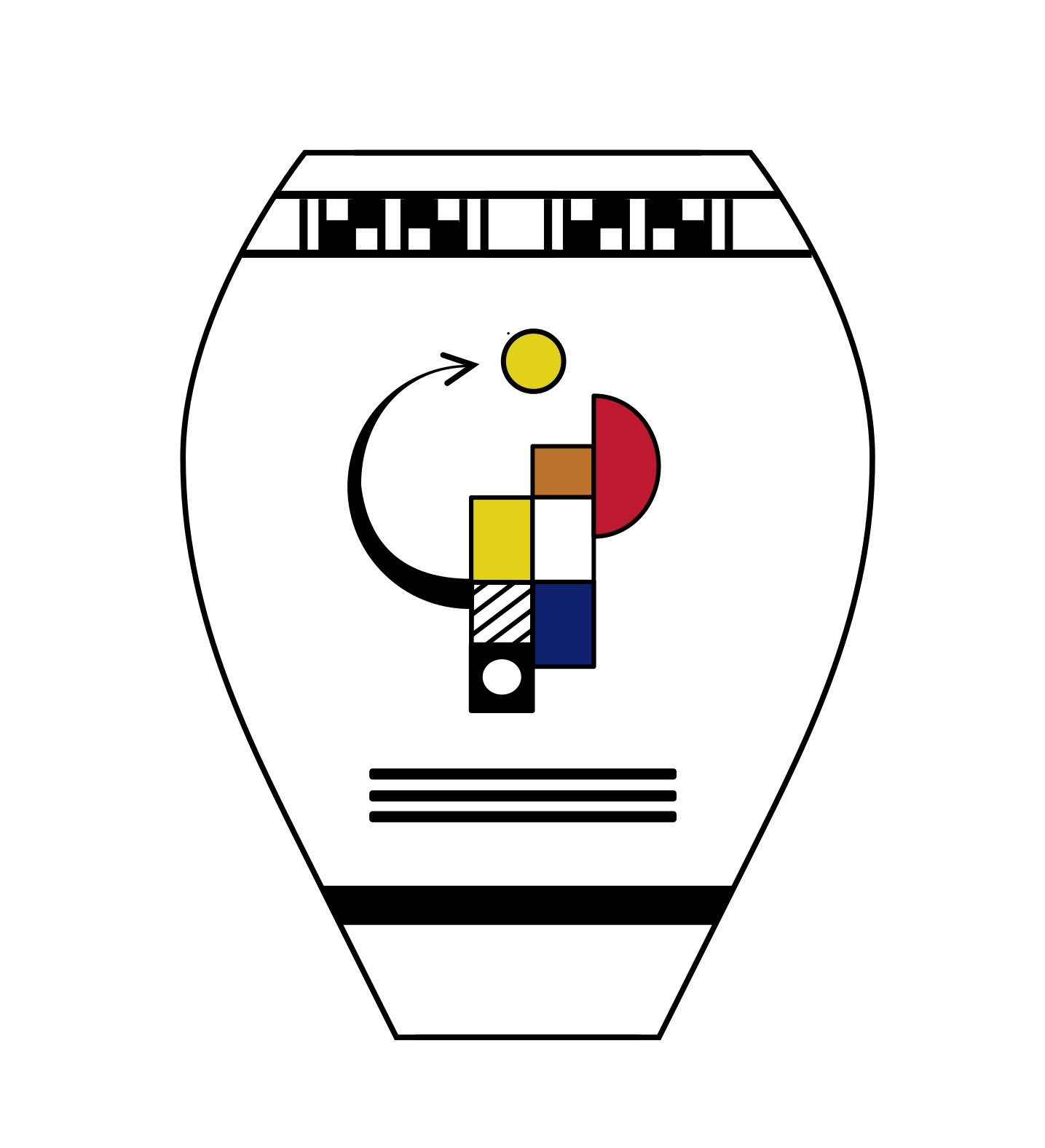
After much thinking about Native American designs (see last post) I decided to not pursue this line of ceramic decoration. Rather, I am now working on some new abstract designs, and have translated several of these patterns, using colored underglazes, to greenware. It be a while before any firing occurs; more to follow on that. Design examples are pictured. I made these using vector graphics with Inkscape, a truly free public domain software that is a good substitute for Adobe Illustrator.
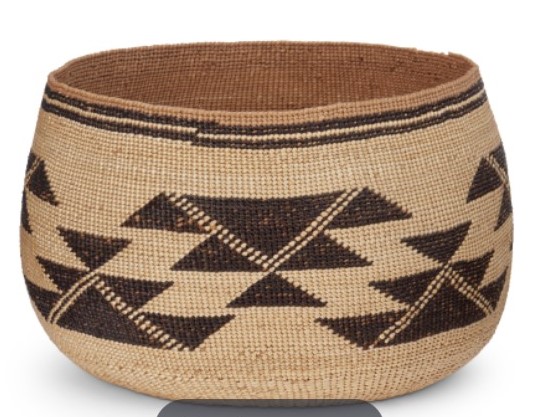
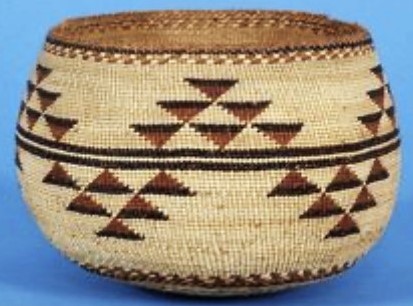
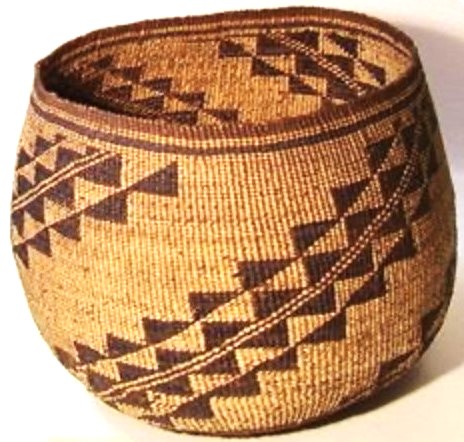
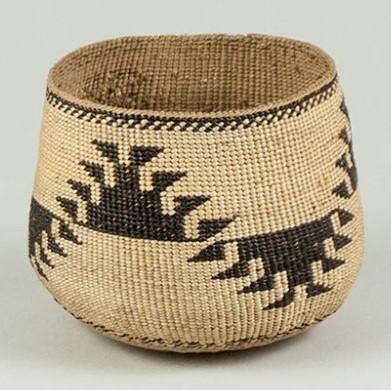
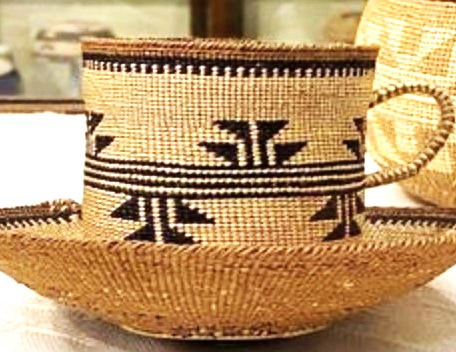
In extreme northern California, along the lower Trinity and the upper Klamath rivers, woven baskets and cups such as these convey tribal cultural language as well as illustrate the art-craftmanship of the region.
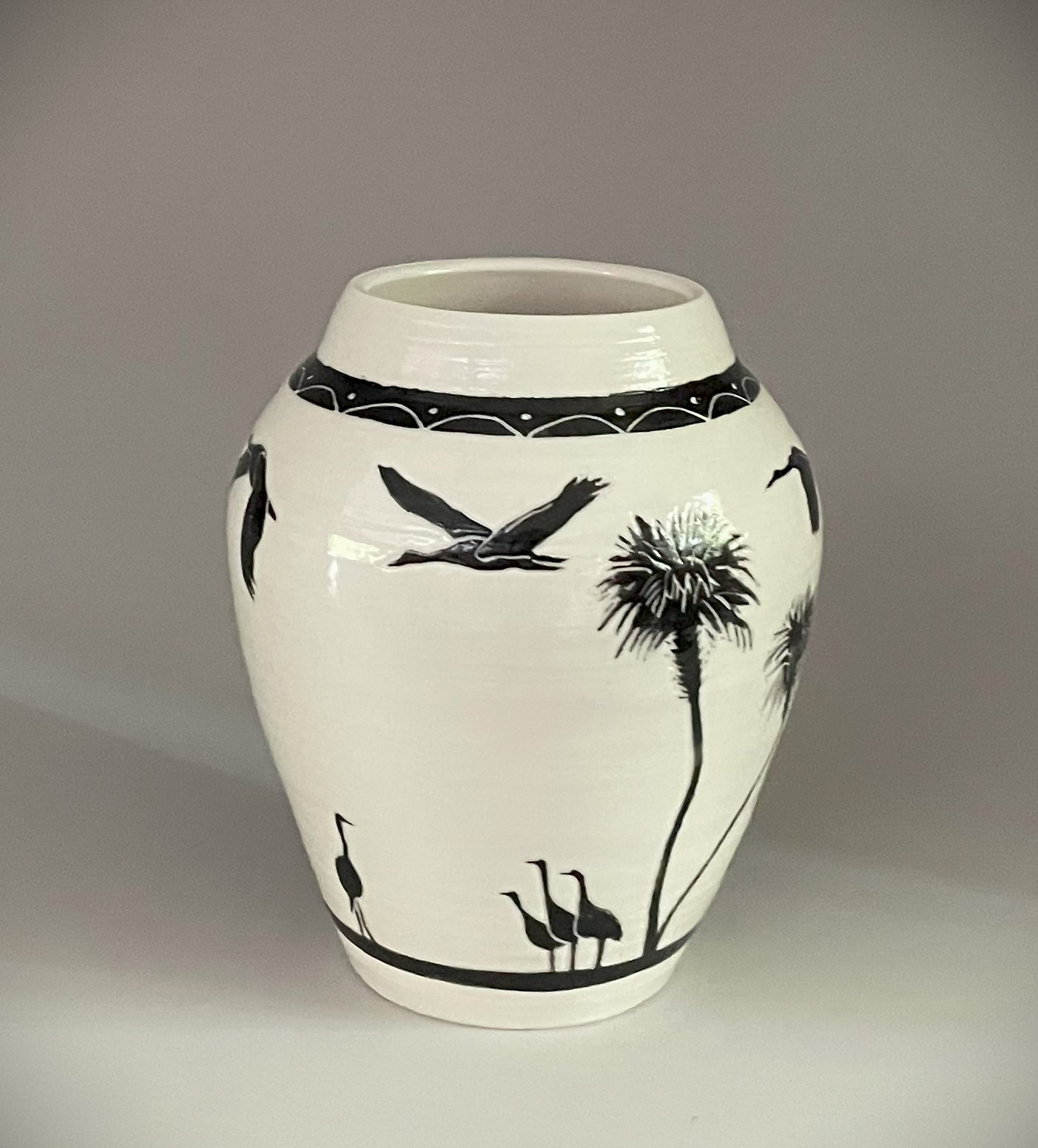
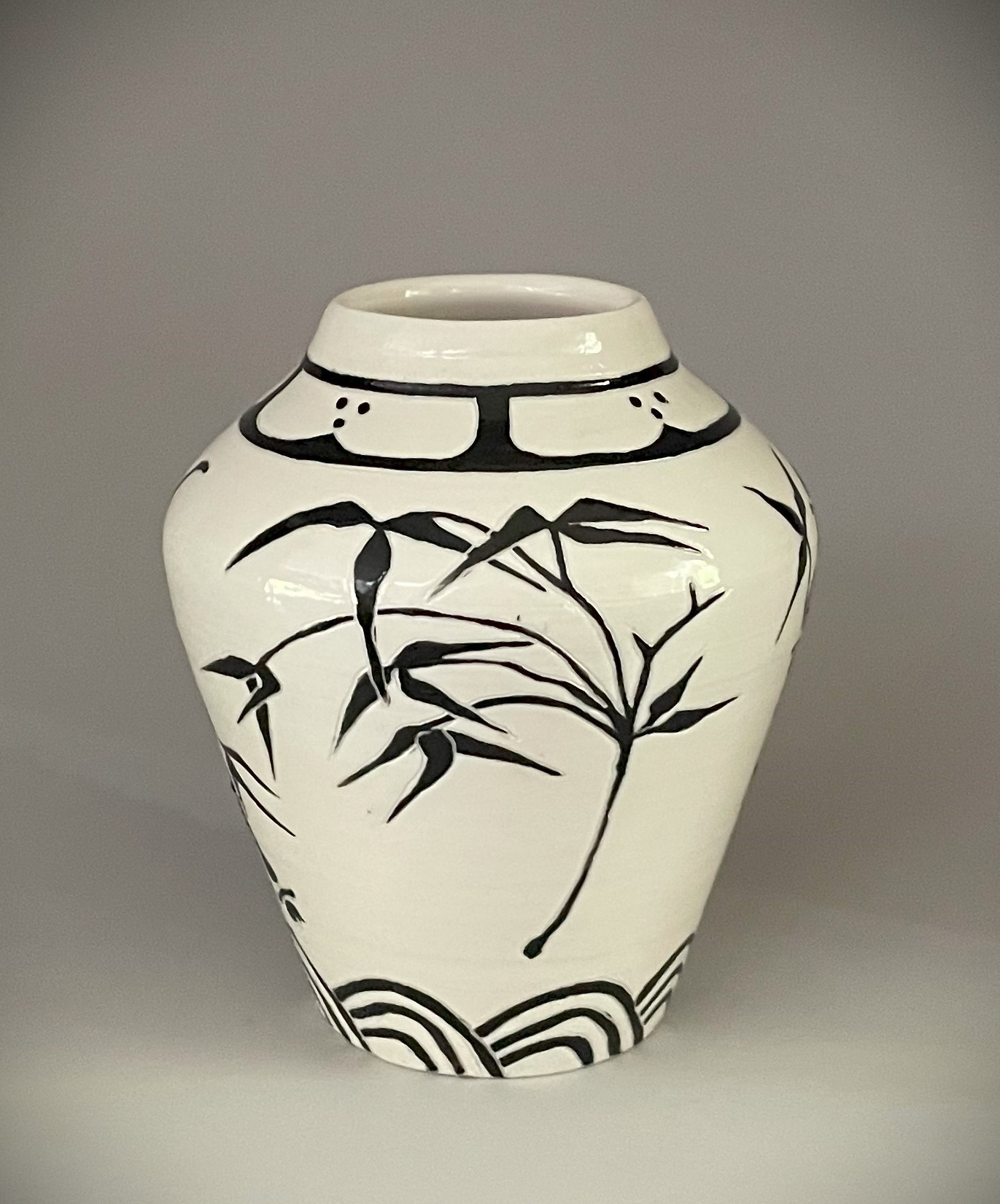
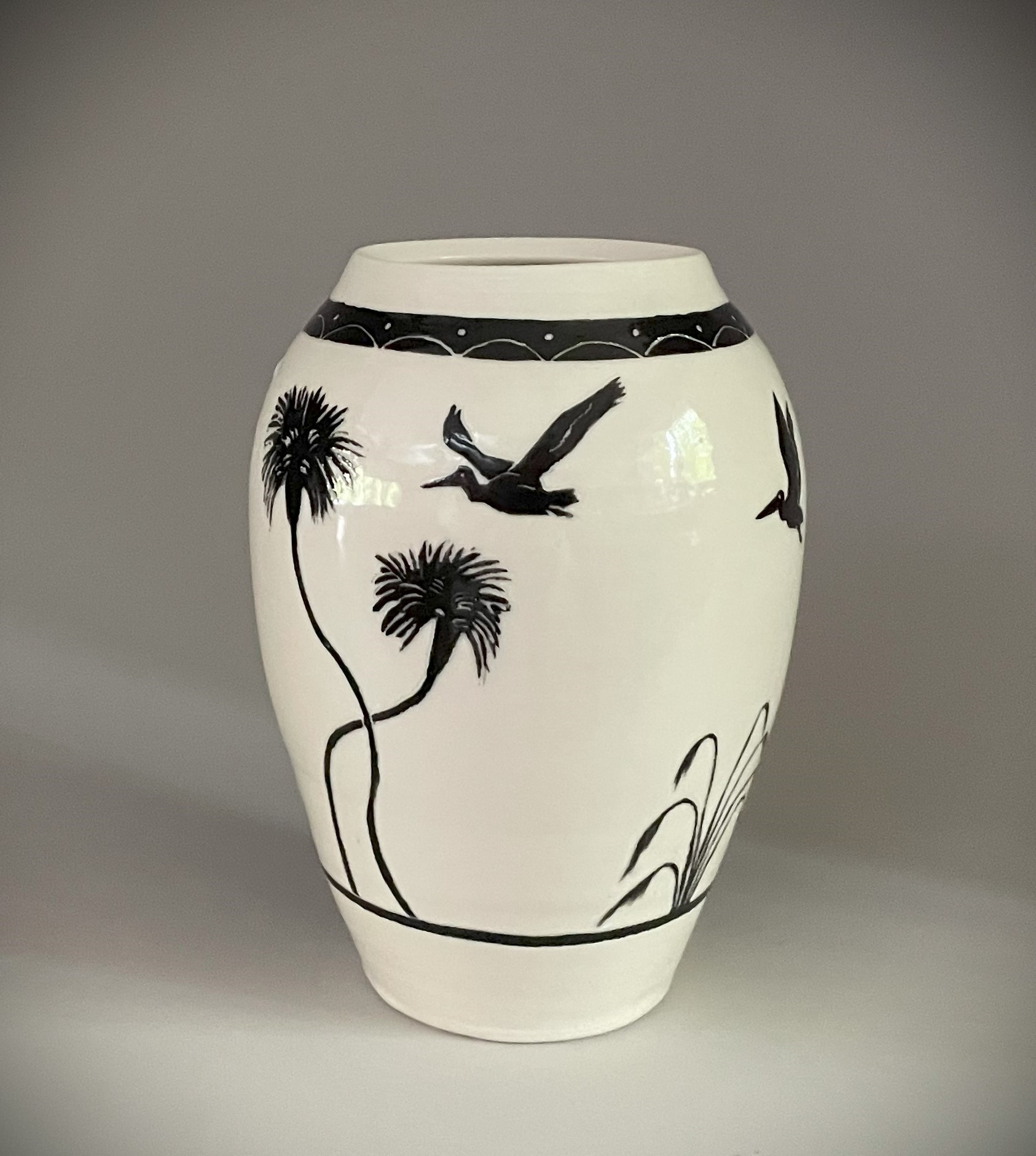
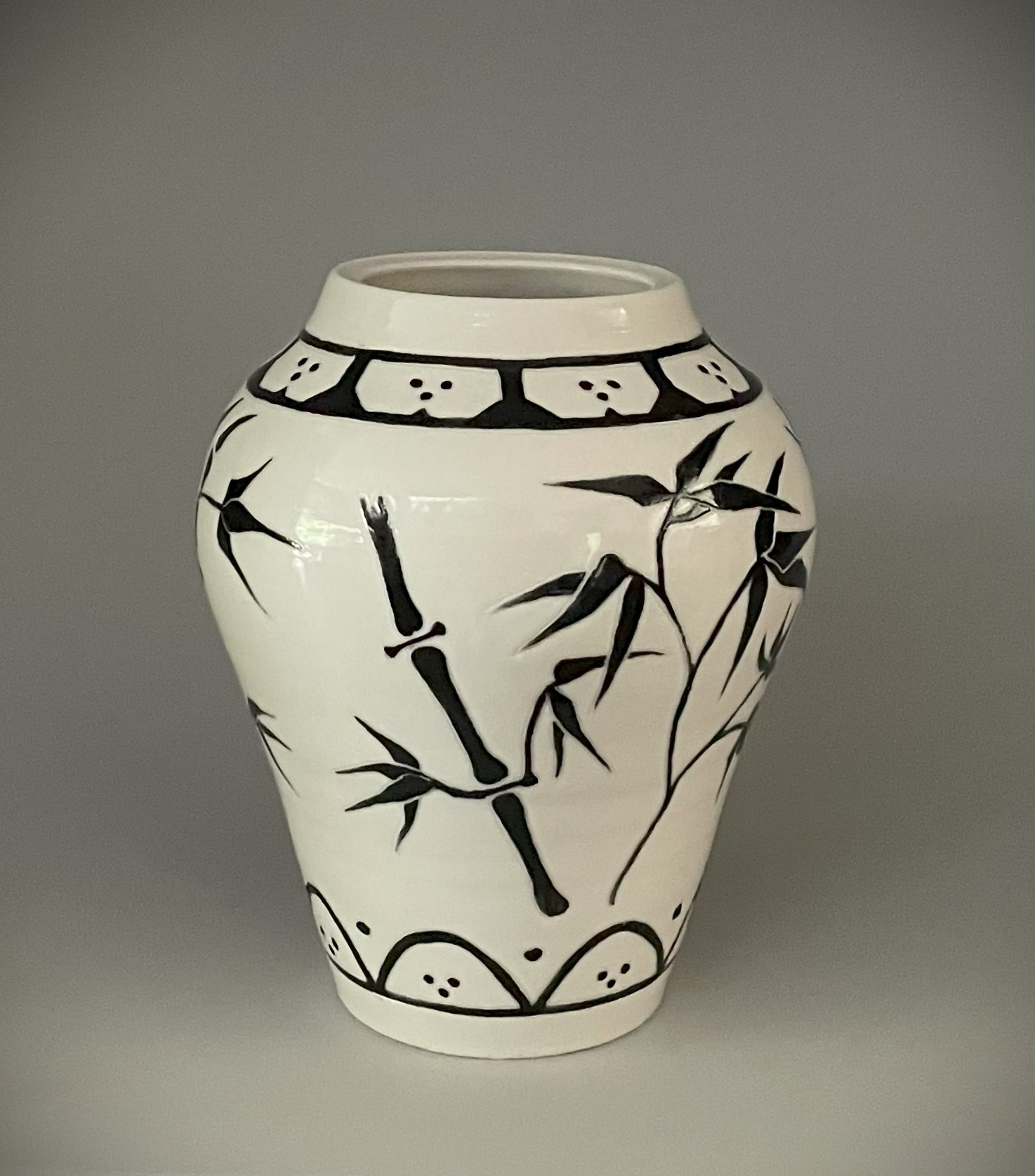
I’ve been searching for a glossy clear glaze to cover the sgraffito on my porcelain vases. These are my most recent results and I’m happy with them. The glaze recipe (which I found somewhere on the web) is:
ULATRA CLEAR GLAZE RECIPE cone 5/6 oxidation.
Minspar 200 (I substitued with F4): 8.6%
frit 3134 23.2
wollastonite 15.2
E.P.K 24.8
talc 4.3
Silica 325 23.8
Cranes and Palms, 6″Bamboo and water motifPelicans and PalmsBamboo and water motifs
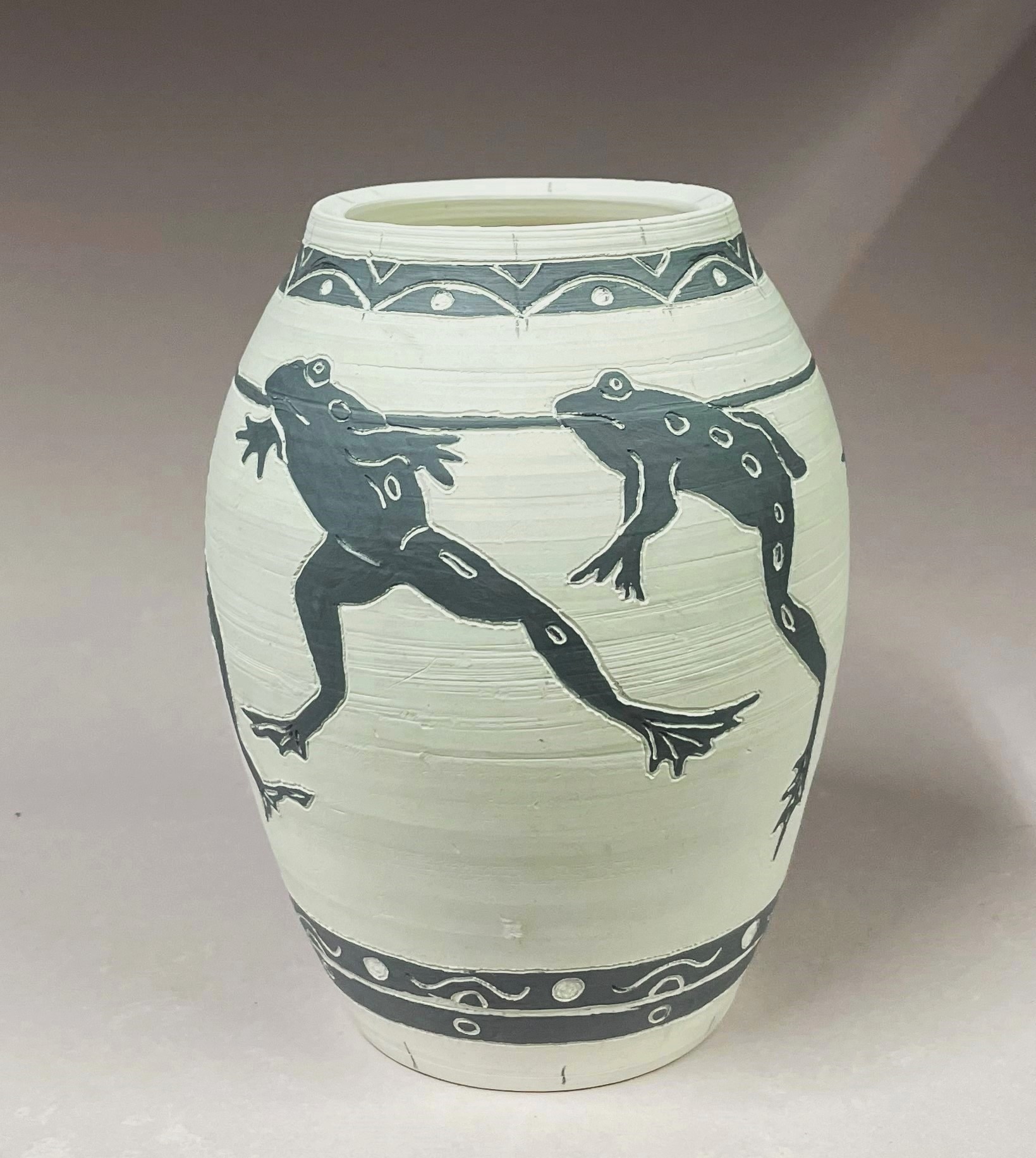
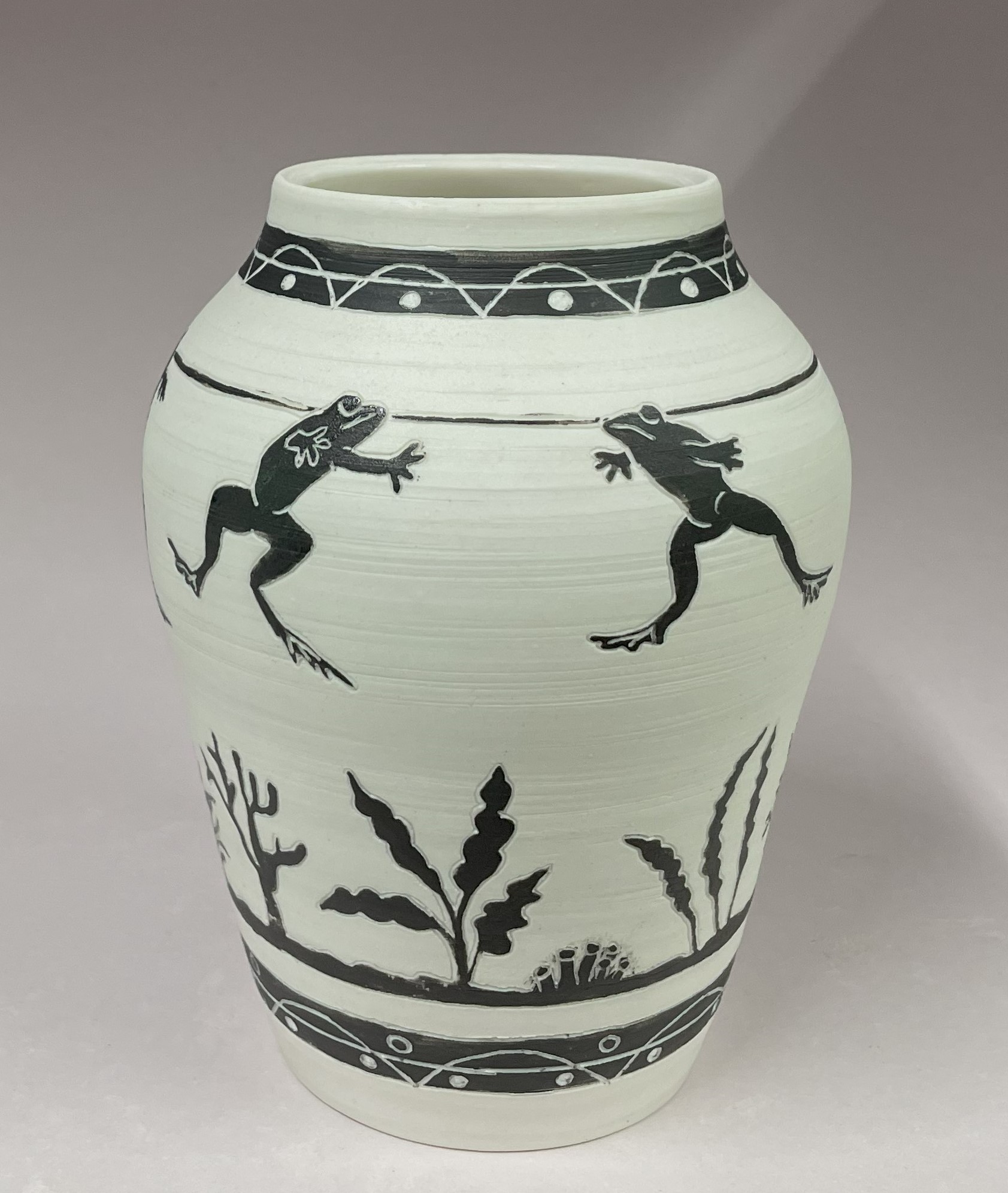
It has been more that a year since I have done any ceramic work. Now, I am back in the studio working on a “fine” art type of porcelain vase. The one on the left is greenware. I use Mayo UG-50 jet black underglaze applied to the leather hard vase and, just as soon as the underglaze dries (two coats needed), I use an etching stylus to outline the figures or do scrafitto designs on the top and bottom black bands. The green ware is then dried and fired straight to cone 6; no bisque stage involved. The outside is not glazed but there is a clear glaze inside. The outside is then lightly finished using 220 grit wet-to-dry sandpaper. The porcelain is Kota cone 5-6 (Kentucky Mudworks).